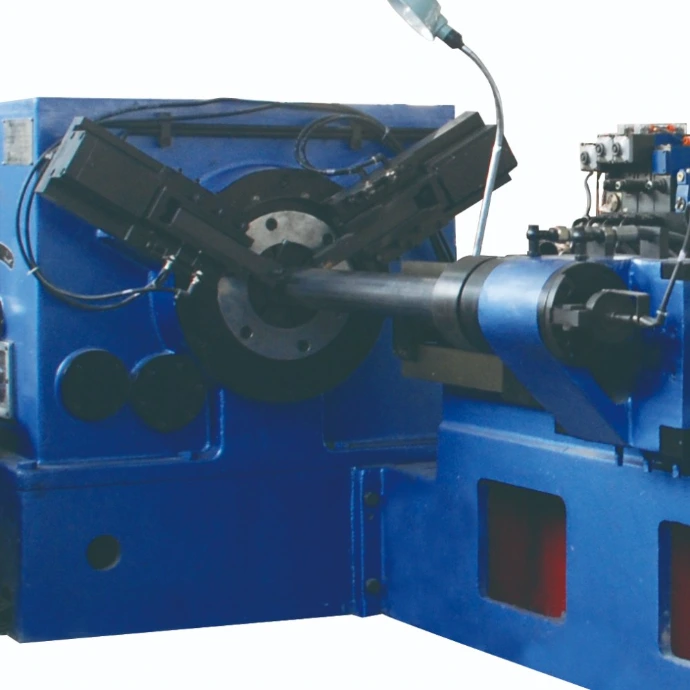
Fixed-Length Pipe Cutting Machine
We operate two fixed-length automatic pipe cutting and chamfering machines dedicated to conveyor roller manufacturing. Each machine delivers a length accuracy of ±0.5 mm and a throughput of up to 800 pipes per shift.
This controlled cutting and chamfering process ensures:
Consistent and repeatable pipe lengths, critical for roller concentricity and balance
Burr-free, chamfered edges, eliminating sharp corners that can damage conveyor belts during operation
As a result, downstream assembly accuracy is improved and belt safety is inherently protected.
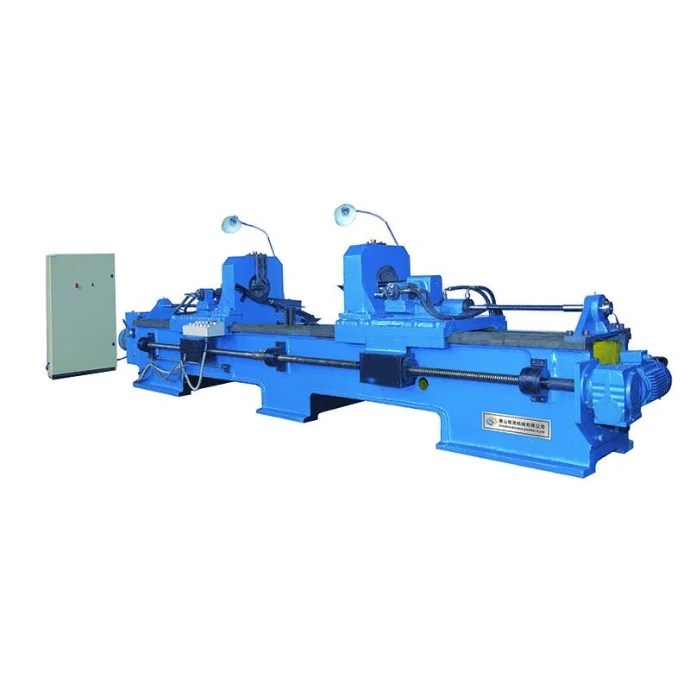
Double-Side Pipe Boring Machine
We operate two double-side pipe boring machines that machine both tube ends simultaneously, ensuring precise alignment between bearing seats.
This process is critical for:
Maintaining tube-to-bearing concentricity
Minimizing runout in the assembled roller
Improving bearing life and dynamic performance
Simultaneous end machining eliminates cumulative errors associated with single-side operations and directly enhances roller reliability in service.
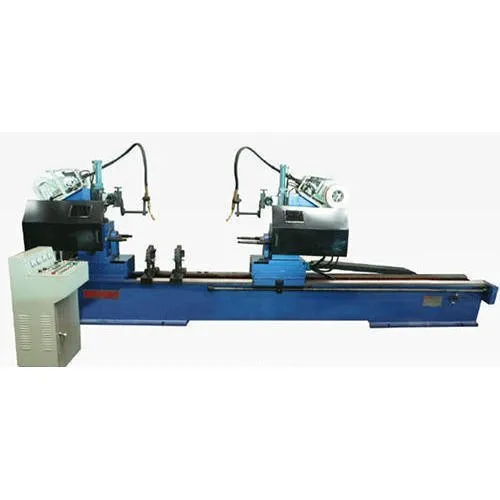
Dual Head Welding Machines
We operate two in-house–designed double-side welding machines, developed using our extensive experience in building special purpose machines (SPMs).
These machines weld both ends simultaneously and in alignment, which:
Preserves roller concentricity during welding
Prevents distortion caused by heat imbalance
Maintains true bearing seat alignment
Directly contributes to longer conveyor roller service life
By controlling the welding process through purpose-built equipment rather than standard fixtures, we ensure consistent structural integrity and superior field performance of our rollers.

Powder Coating Machines
We operate an automated in-line powder coating system designed for conveyor roller production, ensuring uniform coating thickness and consistent surface finish.
This controlled process:
Provides superior corrosion resistance
Improves surface durability during handling and operation
Significantly increases the storage life of rollers
Ensures repeatable quality across high-volume production
As a result, rollers retain their protective finish and performance integrity even during extended storage and transportation.
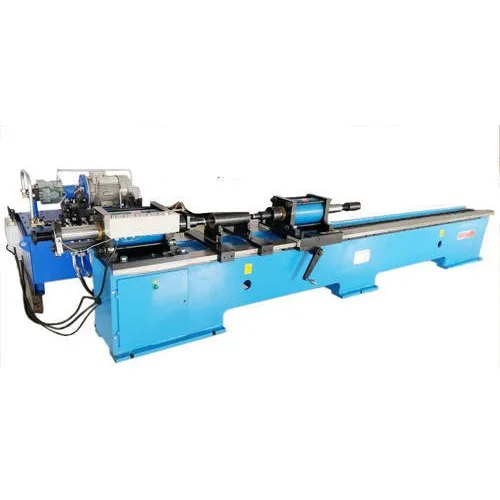
Pressure Controlled Bearing & Seal Assembly
We operate a pressure-controlled bearing and seal assembly machine to ensure precise and repeatable installation of critical rotating components.
This controlled assembly process:
Prevents bearing preload and seal damage
Maintains correct axial and radial alignment
Eliminates installation-induced stresses
Directly improves bearing life and seal effectiveness
By controlling assembly forces rather than relying on manual methods, we ensure long-term reliability and extended service life of conveyor rollers.
TIR Checking Test Rig
We use a dedicated TIR (Total Indicator Runout) checking test rig to verify the rotational accuracy of every conveyor roller.
This inspection ensures:
Controlled radial and axial runout within specified limits
Verification of tube, shaft, and bearing seat concentricity
Early detection of welding distortion or assembly misalignment
Smooth rotation, reduced vibration, and lower bearing loads
TIR validation is a critical quality gate that directly impacts roller balance, bearing life, belt tracking, and overall conveyor reliability in mining, cement, and heavy-duty applications.
Rotational Resistance Testing
We conduct rotational resistance testing on conveyor rollers using a dedicated test rig to measure the starting and running torque of the assembled roller.
This test verifies:
Bearing and seal friction levels
Quality of bearing fitment and alignment
Effectiveness of sealing without excessive drag
Energy losses contributed by the roller
Low and consistent rotational resistance is essential for:
Reduced conveyor power consumption
Lower belt tension
Improved bearing life
Long-term system efficiency
This test ensures that rollers are not only dimensionally correct, but also mechanically efficient under real operating conditions.
Friction Factor Testing
WWe perform friction factor testing to quantify the rolling resistance contribution of conveyor rollers under controlled conditions. This test evaluates the combined effects of bearing quality, seal design, lubrication, alignment, and assembly accuracy.
The test verifies:
Coefficient of rolling resistance (f) at defined radial loads
Consistency across production batches
Impact of seal drag and bearing fit
Energy losses attributable to rollers
Engineering significance:
Lower friction factor directly translates to reduced conveyor power demand
Lower belt tension and drive loads
Improved bearing life and thermal stability
Measurable lifecycle cost reduction, especially on long overland and high-capacity conveyors
Friction factor testing bridges the gap between catalogue compliance and real system efficiency, ensuring rollers deliver predictable energy performance in the field, not just dimensional conformity.
Water Resistance Testing
We conduct water resistance testing to validate the effectiveness of roller sealing systems against water ingress under simulated site conditions.
This test evaluates:
Seal integrity under continuous water spray or immersion
Ingress protection at bearing and shaft interfaces
Seal performance under rotation
Resistance to wash-down and rain exposure
Engineering relevance:
Prevents bearing contamination and premature failure
Ensures reliable operation in wet, humid, and monsoon-prone environments
Protects lubrication integrity
Extends roller service life in mining, cement, and port applications
Water resistance testing ensures that sealing performance is proven under realistic exposure conditions, not assumed from seal design alone—directly supporting long-term conveyor reliability and reduced maintenance risk.
Dust Resistance Testing
We perform dust resistance testing to assess the ability of conveyor roller sealing systems to prevent fine particulate ingress under simulated operating conditions.
This test evaluates:
Seal effectiveness against fine and abrasive dust
Ingress protection at bearing and shaft interfaces
Seal performance during continuous rotation
Resistance to contamination in high-dust environments
Engineering relevance:
Prevents abrasive wear of bearings and races
Maintains lubrication cleanliness
Reduces premature bearing failure
Ensures reliable operation in mining, cement, power, and aggregate handling applications
Dust resistance testing confirms that sealing systems are validated for real plant conditions—where airborne dust, not load alone, is often the primary cause of conveyor roller failure.